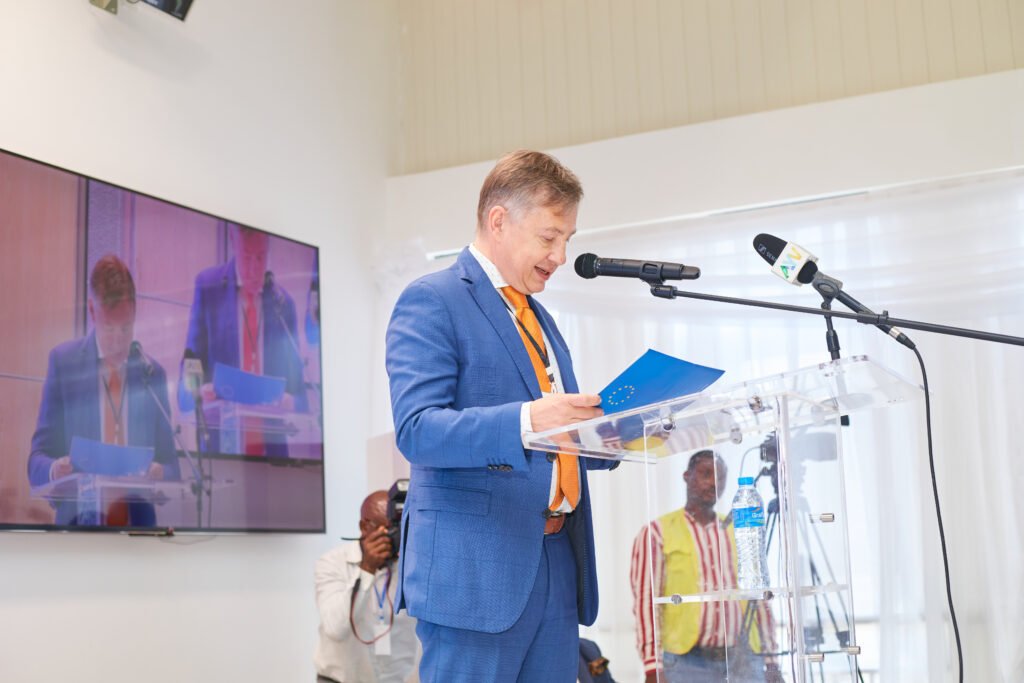
Sierra Leone’s manufacturing sector entered a new chapter of ambition and clarity during the 2025 Manufacturers Dialogue Conference and Exhibition — the first of its kind in the country’s history. What unfolded over two days at the Freetown International Conference Centre was more than a technical dialogue; it was a sector-wide mobilisation, backed by strong political leadership, broad stakeholder commitment, and a clear national vision for industrial transformation.
With over 800 participants, 50 exhibitors, representatives from the Presidency, Parliament, cabinet ministries, development partners, academia, and industry associations, the conference signalled a united front: manufacturing is central to the country’s next decade of economic growth.
A Sector Ready for Reset
The manufacturing sector has endured difficult chapters — civil conflict, Ebola, COVID-19, inflationary pressures, and infrastructure constraints. Yet it has continued to rebuild quietly. Recent GDP rebasing revealed a striking fact: manufacturing now contributes 22% of Sierra Leone’s GDP. This discovery reaffirmed what many had long argued — manufacturing is no longer a peripheral sector; it is a pillar of national development.
The conference therefore served as both a reality-check and a renewal moment. Sierra Leone possesses entrepreneurial talent, raw materials, and a growing base of local industries — from agro-processing to light manufacturing, petroleum by-products, ICT assembly, beverages, and construction inputs. But the enabling environment must catch up.
A Turning Point Guided by Presidential Directives
His Excellency the President’s keynote address was the defining moment of the conference. He issued three strategic directives that now form the backbone of Sierra Leone’s new industrial ambition:
- Launch of the “Made in Sierra Leone” Presidential Promotion Initiative
A national drive to promote local products, unify brand identity, strengthen domestic value chains, and boost confidence in homegrown industries.
- Development of the National Manufacturing Roadmap (2025–2030)
A five-year framework to establish clear industrial priorities, attract investment, guide public–private collaboration, and position Sierra Leone competitively in regional markets.
- Establishment of a National Manufacturing Pact
A coordinated commitment between government, private sector, development partners, financial institutions, technical agencies, and academia — aligning resources and responsibilities under a shared national agenda.
These directives provided the clarity that manufacturers have long called for: predictability, policy coherence, and a unified national direction.
A Conference Rich in Dialogue, Deep in Substance
Across six technical panels, manufacturers and policymakers confronted longstanding bottlenecks head-on:
- High energy costs and unreliable power supply
- Difficulty accessing land and industrial zones
- Limited access to finance and high interest rates
- Gaps in standards, testing facilities, and quality certification
- Weak linkage between industry, academia, and innovation systems
- Persistent barriers affecting women and youth-led enterprises
- Underutilised agro-processing potential despite rich agricultural base
Speakers and panellists from MTI, ECOWAS, UNIDO, UNDP, the EU-BECS Programme, academia, and the private sector offered concrete solutions that will now inform the forthcoming Manufacturing Roadmap.
A Public–Private Mobilisation on an Unprecedented Scale
What made the conference historic was not only the scale of participation but the diversity of voices:
- Local manufacturers (small to large)
- Chambers and business associations
- Financial institutions and investment bodies
- Academia and research institutions
- Standards and regulatory agencies
- Youth and women entrepreneurship groups
- International development partners
- Government ministries, departments, agencies, and policymakers
For the first time, every segment of Sierra Leone’s industrial ecosystem sat at the same table, diagnosing the same issues and working toward the same horizon.
A New Social Compact for Sierra Leone’s Industrialisation
The communique closed with a clear message: the future of Sierra Leone’s economy must be built, not imported. This means investing in competitive industries, empowering MSMEs, strengthening standards, modernising infrastructure, lowering the cost of production, and building human capital.
But it also means shifting national mindset — from consuming imported goods to prioritising value addition, local production, and innovation.
The 2025 Manufacturers Conference has set that shift in motion. With presidential directives in place, institutional momentum rising, and a more unified private sector, Sierra Leone has entered a phase of manufacturing reboot grounded in policy clarity and national ambition.