Sierra Leone took a decisive step toward rewriting its place in Africa’s trading future as government leaders, regional institutions, development partners, and private-sector actors convened in Freetown for the Sierra Leone AfCFTA Regional Conference, held 14–17 October 2025.
Hosted at the Foreign Service Academy, the four-day gathering did more than tick boxes on continental obligations — it signalled Sierra Leone’s readiness to shift from preparation to participation under the African Continental Free Trade Area (AfCFTA), the world’s largest free trade zone.
With representatives from the AfCFTA Secretariat, ECOWAS Commission, UNDP, UNECA, ITC, WTO-EIF, development partners, and business networks across the region, the conference brought a rare depth of expertise, political commitment, and private-sector engagement into one room.
A defining moment in Sierra Leone’s regional integration journey
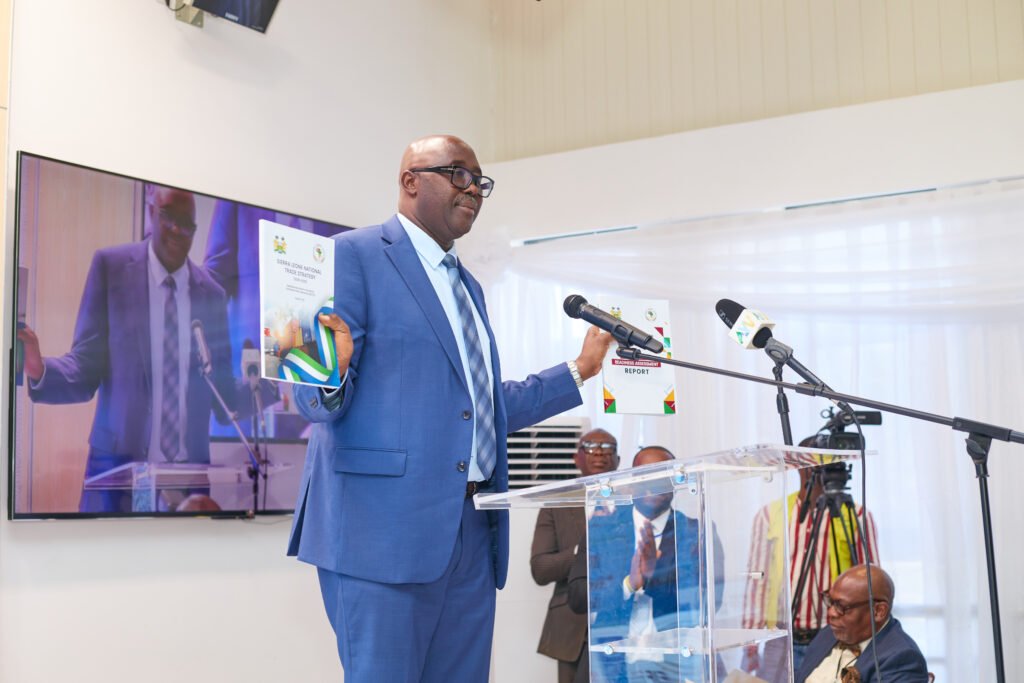
The conference marked a turning point as Sierra Leone unveiled three foundational instruments that anchor its readiness to trade under AfCFTA:
- The AfCFTA Readiness Assessment
- The gazetted Provisional Schedule of Specific Commitments on Trade in Goods
- The updated National Trade Strategy, themed “Repositioning Sierra Leone to Trade under the AfCFTA”
Together, these tools outline what Sierra Leone must strengthen — its customs systems, productive capacity, standards infrastructure, SME competitiveness, and policy coordination — to compete in a continental market of 1.4 billion people and a combined GDP of USD 3.4 trillion.
The conference confirmed what many had anticipated: Sierra Leone is transitioning from policy planning to actual trading under the Guided Trade Initiative (GTI).
Government: “This is Sierra Leone’s moment to compete and win”
Opening the conference on behalf of the President, the Minister of Trade and Industry, Alpha Ibrahim Sesay, placed the event squarely within the country’s broader economic reforms.
He highlighted measurable progress, including:
- GDP growth of 4% (2024) and 4.5% projected (2025)
- Inflation dropping from 54.5% (2023) to below 9% by April 2025
- 18% growth in domestic revenue
- Public debt lowered to 39.5% of GDP
- A stabilised exchange rate and renewed investor confidence
He underscored that the AfCFTA perfectly aligns with the Government’s Big Five Game Changers, notably Feed Salone, industrialisation, digital transformation, and youth employment.
He affirmed bluntly — and optimistically — that the conference marked the “official commencement of Sierra Leone’s participation in the Guided Trade Initiative.”
Partners recognise Sierra Leone’s leadership
ECOWAS praised Sierra Leone as a “beacon of regional and continental ambition,” recognizing it as the first West African country to complete an AfCFTA Readiness Assessment.
EU Ambassador acknowledged Sierra Leone’s progress in customs reforms, strategy development, and trade facilitation, calling the conference a “critical step toward operational readiness.”
AfCFTA Secretary-General commended Sierra Leone’s pace, describing its readiness assessment, tariff schedule, and institutional coordination as “best practice for the continent.” He emphasized the next challenge: turn readiness into recurring trade flows.
The sessions: high-level dialogue, practical insights, real commitments
Across four intensive days, speakers and panellists unpacked the technical and strategic foundations of AfCFTA implementation:
- Rules of Origin was explained as the gatekeeper to AfCFTA benefits, enabling firms to qualify for preferential tariffs.
- Sessions on ECOWAS preparedness highlighted the need for harmonised regulations, stronger customs systems, and improved access to trade finance.
- Sessions on Digital tools & PAPSS showcased the role of instant cross-border payments in reducing costs and boosting intra-African trade.
- Sessions on Intellectual Property positioned IP as a strategic asset for competitiveness, branding, and value addition.
- Sessions on Public–Private Partnerships (PPPs) framed PPPs as key to unlocking infrastructure, logistics, and digital trade systems.
- Sessions on Women & Youth in Trade Protocol emphasized the need to eliminate gender- and age-based barriers in trade processes, finance, skills, and border procedures.
- Sessions on Digital Trade Protocol outlined the architecture for a unified African digital marketplace with harmonised rules on e-commerce, payments, data protection, and cybersecurity.
- Sessions on Quality standards & value chains reinforced the centrality of standards in regional value chains and the competitiveness of Sierra Leonean producers.
A unifying call: Turn commitments into movement of goods, services, and ideas
The conference closed with a clear message: Sierra Leone cannot afford to remain at the margins of continental trade.
The Minister of Trade and Industry urged government, private sector, and development partners to “move beyond declarations,” strengthen institutions, and translate frameworks into cross-border transactions.
The four-day dialogue sharpened national priorities, strengthened inter-agency collaboration, and positioned Sierra Leone to enter AfCFTA markets with increasing confidence.
Sierra Leone has now taken the critical first steps — the next phase is to trade, grow, and compete.