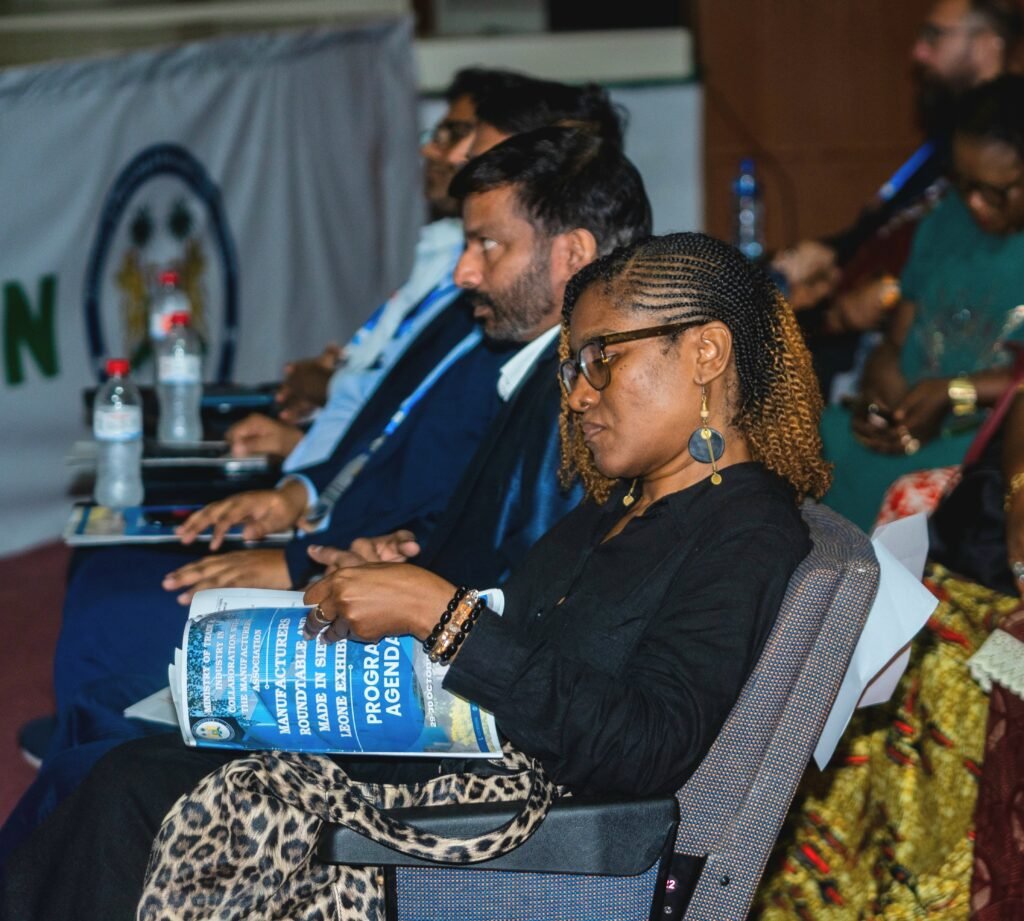
Sierra Leone’s 2025 Manufacturers Conference did more than gather policymakers and CEOs under one roof — it signalled a decisive shift in how the country intends to rebuild its industrial base. Anchored by the President’s message and the Minister of Trade and Industry’s charge to the sector, the event outlined a new era of manufacturing competitiveness rooted in policy coherence, sector organisation, and productivity-led growth.
The tone was clear: Sierra Leone cannot rely on fragmented, small-scale production and expect to compete regionally. Manufacturing must evolve into a structured, innovation-driven, export-ready engine — and Government is prepared to back that shift.
A Presidential Directive: Industrialisation as a National Imperative
The conference opened with a strong policy signal from His Excellency the President. The President positioned manufacturing not as an optional pillar but as a non-negotiable driver of the national economy under the Big Five agenda. He stressed that industrialisation, value addition, and job creation are indispensable if Sierra Leone is to transition from a consumption-heavy economy to a production-led one.
This framing set the foundation for the rest of the conference: manufacturing must become a coordinated national project, not a dispersed set of isolated enterprises.
A New Organised Framework for Growth
A major outcome of the conference was the strong consensus that Sierra Leone needs a structured approach to organising its manufacturing sector. Beyond equipment and financing, manufacturers emphasised predictable policies, coordinated regulatory systems, and a unified voice through industry associations.
Whether it is agro-processing, light manufacturing, construction materials, or furniture production — every operator echoed the same message:
“We cannot scale without an ecosystem that works.”
This renewed organisational push is now being aligned with the upcoming National Industrialisation Policy (2025–2035), which places emphasis on clustering industries, strengthening standards, developing industrial zones, and incentivising value-chain integration.
Quality, Standards, and Competitiveness Take Centre Stage
From the Sierra Leone Standards Bureau to development partners, a consistent theme emerged: competitiveness begins with quality infrastructure. Manufacturers openly acknowledged that without certification capacity, testing facilities, and harmonised standards, the country cannot grow its export footprint.
The call to invest in national quality infrastructure was strong — and the conference made it clear that standards are not a bureaucratic hurdle but the foundation of industrial success.
Local Production as a Strategic Economic Priority
Participants repeatedly highlighted the urgency of producing more locally. The President’s policy direction reinforced that Sierra Leone must reduce dependency on imports, support domestic production, and strengthen resilience across essential value chains.
This shift reflects a deeper commitment:
- More domestic jobs
- More value retained in-country
- More opportunities for SMEs to link into supply chains
- More manufacturing inputs sourced from local agriculture and mining
Under this agenda, every Leone spent on local production becomes an investment in national economic stability.
Government and Private Sector: A Re-energised Partnership
The conference was also a turning point for public–private collaboration. Manufacturers acknowledged improved engagement from the Ministry of Trade and Industry, while reaffirming their readiness to partner more constructively.
Stakeholders agreed on four areas requiring joint action:
- Policy coordination and stability
- Infrastructure and energy improvements
- Standards and certification capacity
- Access to finance and affordable credit
The consensus was unmistakable — neither government nor industry can achieve the needed transformation alone.
A Country at an Industrial Crossroads
If the AfCFTA Conference positioned Sierra Leone regionally, the Manufacturers Conference clarified the domestic agenda: the future of the economy depends on how manufacturing evolves over the next five to ten years.
The conversations, commitments, and policy directions shared in Freetown point to a sector that is ready to reorganise, scale, and become more competitive. But they also underscore that significant work remains — from energy reliability to standards, skills, and financing.
Still, the momentum is real.
The vision is clear.
And for the first time in a long time, the manufacturing community is aligned behind a shared transformation agenda.
Sierra Leone is not just talking about industrialisation anymore — it is beginning to build it.