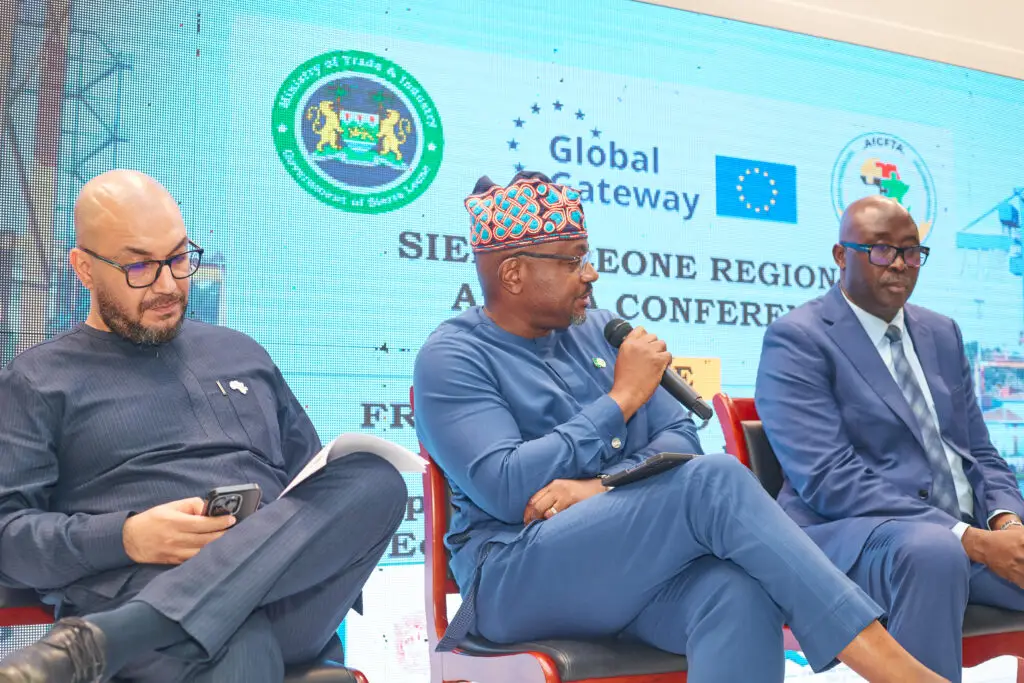
Sierra Leone’s ambition to become a competitive player under the African Continental Free Trade Area (AfCFTA) took centre stage during the October 2025 National AfCFTA Conference in Freetown. Over four days, regional bodies, development partners, the private sector, and government agencies openly acknowledged Sierra Leone’s progress — highlighting the country as a reform-driven, increasingly coordinated, and forward-looking actor in the emerging single African market.
Unlike typical technical gatherings, this conference became a moment of affirmation. The country’s readiness efforts, institutional reforms, and alignment with AfCFTA priorities drew consistent commendation from high-level representatives from the ECOWAS Commission, the EU Delegation, and the AfCFTA Secretariat.
A Landmark Achievement: Completion of the AfCFTA Readiness Assessment
Throughout the conference, partners highlighted one achievement repeatedly: Sierra Leone is one of the first countries in the region to complete a full AfCFTA Readiness Assessment — an exercise designed to evaluate legal, policy, infrastructure, and institutional gaps ahead of trading under AfCFTA.
Representatives described this as a “bold” and “strategic” step that signals the country’s seriousness to the continental market. The AfCFTA Secretariat referred to Sierra Leone’s approach as “a model of best practice”, drawing attention to the structured coordination between ministries, agencies, and private sector actors.
Policy Reform Momentum Recognised
Partners also highlighted Sierra Leone’s ongoing reforms and policy alignment work, including:
- Gazetting of tariff schedule commitments
- Progress on finalising the National Trade Strategy
- Customs modernisation efforts
- Strengthened inter-agency coordination on trade matters
This alignment was noted as essential for translating continental opportunities into real economic gains. The ECOWAS Commission described Sierra Leone’s coordination process as “symbolic of serious regional intent.”
EU Support: Recognising Progress While Highlighting the Road Ahead
The EU Delegation in Sierra Leone played an active role in the discussions, reaffirming the EU’s technical and institutional support to the Ministry of Trade and Industry. The Delegation recognised Sierra Leone’s steady advancement while also underlining that meaningful participation in the AfCFTA will require continued strengthening of institutional capacity, improved trade facilitation systems, and deeper private sector readiness.
In a forward-looking spirit, the EU emphasised that this is precisely where its support to MTI is focused—helping address the remaining gaps so Sierra Leone can fully harness the benefits of continental market integration.
This balanced perspective was reflected in the conference outcomes, pointing to a strong partnership anchored in both progress achieved and work still ahead.
Why Sierra Leone Stands Out in the Region
Sierra Leone’s emerging leadership derives from five core strengths:
- A completed AfCFTA Readiness Assessment — rare among regional peers.
- Clear alignment between national policies and AfCFTA frameworks.
- Strong institutional commitment from trade-related MDAs.
- Rising levels of private-sector engagement in national policy processes.
- Momentum in customs, standards, and tariff-related reforms.
These elements position Sierra Leone as one of the West African countries most actively preparing for continental market integration.
What This Means for Sierra Leone’s Future Competitiveness
The conference underscored that Sierra Leone has moved beyond aspiration and is now entering a phase of structured implementation. With readiness foundations established, the next steps involve deepening coordination, accelerating institutional strengthening, and expanding support to MSMEs so the private sector can compete effectively in continental value chains.
The message emerging from partners was clear: Sierra Leone has built credibility through preparation, but sustained effort will determine the country’s long-term competitiveness under AfCFTA. With strong political will and continued support from development partners — including the EU — the country is well-positioned to navigate this next phase with confidence.